• Work
  • About
  • Blog
  • Contact
Menu

David Lux

Brand · Growth | Orange County, California
  • Work
  • About
  • Blog
  • Contact

Beyond the Brochure: Where "Ultimate Driving Machine" Becomes Reality at the BMW Performance Center

February 29, 2024

When I was in high school my parents had a BMW 3 Series wagon. I have so many fond memories of this car. Once on the road, this seemingly demure family hauler truly embodied the brand’s late ‘90's to early 2000's slogan: The Ultimate Driving Machine.

Responsive acceleration, grippy brakes, and precise steering, were some of the qualities that made the car an absolute blast to drive. It also handled like a dream thanks to the near perfect 50:50 weight distribution—something of an obsession by BMW engineers.

Simply put, the car was made to be driven. For those who love driving, these qualities are what makes a BMW so thrilling every time you get behind the wheel.

However, BMW didn’t just stop with creating a high-performance product. They’ve long created experiences that showcase what The Ultimate Driving Machine really means to owners and non-owners alike. Perhaps no better place to experience the thrills is at BMW’s Performance Center West. 

Located about 45 minutes southeast of Palm Springs, the driving school consists of several race tracks within a private club in Thermal, California. There are a range of programs available, from a teen driving school to Mini stunt driving program to intense two-day track events. I recently had the pleasure of taking the M Performance Course where I put a BMW M3 Competition through its paces. 

Following some light refreshments in the Center's lounge and instruction space, and a surprisingly quick tutorial on track fundamentals from a seasoned racing driver and instructor, it was time to get behind the wheel. 

Turning on to the racing track, we followed the instructor on a reconnaissance lap to get familiar with the course. Slowly we followed the instructor, mirroring his path, how he turned into each corner, braking when he slowed down, accelerating when sped up 

After only one intro lap, it was time to open up our M3’s. 

With each adrenaline-pumping lap at speed, the instructor continued to provide on-going tips over the radio, like when to brake, reminders to accelerate out of turns, and suggestions to help refine our skills and lap times.

Trying to keep only a few car lengths from the instructor’s car I hit higher and higher speeds—close to 120 mph—and felt the G forces increase as I tamed over 500 horsepower around the twists and turns. 

The experience certainly helped forge my performance driving skills. It also kept the focus on what sets BMW vehicles apart. 

BMW’s promise of building The Ultimate Driving Machine isn’t just about speeds and feeds. It’s about delivering sheer driving pleasure to anyone who gets behind the wheel. 

At BMW’s Performance Center, that ethos is perfectly brought to life in a one-of-a-kind experience. You can see the caliper size of the M3’s massive Brembo brakes on a table of specs, but feeling of their stopping power before heading into a turn and smelling the pads after a pit stop gives you a completely different understanding of the product feature. 

In a crowded marketplace, experiential events like these can help brands stand out from traditional marketing strategies and grab consumer attention. The community built at the performance center was also amazing. Everyone was there for the same reason, and that made for a great day.

This event also perfectly reinforces and envelops participants in the brand message as they learn about products in a fun and interactive way. After all, the path to purchase for premium products is by no means linear. Plus, there’s even an opportunity for brands to gather valuable data and insights to inform future marketing efforts. 

I am not even in-market for a new car, yet somehow I found myself venturing to BMW’s website to learn more about the vehicle I happily tortured around the track. 

While navigating the course, as my heart rate went up, I got closer to understanding my limits, as well as the car’s (considerable) limits. It also revealed that there’s a lot more to BMW than a tagline. That’s the point at which the promise of a slogan gives way to a memorable brand. 

For me, the experience in Thermal brought back childhood memories of that 3 Series wagon I had a love affair with, amid some adolescent mischief. It also reminded me that BMW hasn’t lost their way. Even decades later, at least in my mind, BMW remains The Ultimate Driving Machine.

In Marketing Tags experiential, BMW

Prepare for the Future: How Digital Marketing Will Change in 2024

December 31, 2023

From the explosion of AI to the exploits of X, it’s been an exciting year for social media, e-commerce, and digital marketing in general. 

There are countless trends to watch and predictions to make for next year. Here are just a few of the things I’m thinking about as I look to the year ahead. 

Cookies are Being Deprecated

Third-party cookies for ad targeting and measurement are going away. This is huge. 

According to eMarketer, more than $123 billion in programmatic advertising is transacted via real-time bidding on the open internet—much of that being guided by the use of cookies today. 

As a result, brands, agencies, publishers, and ad tech companies, all have to rethink their media strategies in 2024. The entire advertising industry will shift to new targeting and measurement technologies in the year ahead, if they haven’t already.

Immersive In-person Shopping Experiences

During the pandemic, we loved browsing our favorite products from the comfort of our own homes. However, shopping behavior during this past year indicates something truly shocking, at least to me: brick-and-mortar isn’t going away. 

In-store sales have rebounded post-pandemic, and most businesses are confident that physical stores will continue to play a large role in the purchase journey. 

As such, brands need to invest in enhancing the customer’s in-store shopping experience to stand out from the competition. This is especially important when put into the context of an omnichannel landscape, where shopping can happen anytime, anywhere. 

The journey to the store is no longer just transactional, either. Enjoying the in-store experience is the main reason 35% of consumers shop in-store, and another 24% want to interact with products before buying.

Perhaps the biggest opportunities will be in bridging the online and offline gap, which might include options for: buy online, pickup in-store (BOPIS); buy in-store, ship to home; buy online, return in-store. These will all be important to savvy shoppers in 2024. 

More Selling with Video

Video had a huge impact on the shopping journey this past year, with 54% percent of consumers demanding more video content from brands.

Video will continue to have a massive influence, helping shoppers decide which product or brand to buy, as well as enhance the in-store experience. That’s also why online retailers are introducing more video advertising units and live streams within their platforms. 

Brands will likely embrace more video across social media, where selling via live videos on Instagram, Facebook, TikTok, and others, is likely to grow. That’s apparent in the continued shopping capabilities that are being added to social media platforms. 

Of course, B2C brands are doubling down on short-form video and UGC content for good reason. The ROI on short-form videos is there, and that’s expected to continue next year. 

All Eyes are on YouTube

YouTube always amazes me. I’ve seen success on the platform from my own campaigns and content initiatives. In 2024, it’ll continue to be ripe with opportunities for brands and marketers. 

According to eMarketer, YouTube accounts for more than 20% of ad revenues and time spent with CTV in the U.S. That’s staggering, and it shows that the platform is building a following, even on the big screen. 

YouTube also caters to a wide audience, with Gen Zers and millennials accounting for the majority of viewers. YouTube’s influence is also expanding, fueled by a younger demographic deeply engaged with the platform. While TikTok and Instagram get all the buzz, Pew Research reports that 19% of teens use YouTube “almost constantly.” 

YouTube Shorts specifically shouldn’t be ignored in 2024. While daily views are still eclipsed by Meta’s Reels, YouTube Short generates more than 50 billion daily views and it’s growing rapidly. 

eMarketer predicts that YouTube’s growth will reach double digits in 2024 and 2025 and will exceed Hulu by 2025. That is just incredible and reveals the impact that YouTube still has on audiences. 

A Shift to Nano-influencers

Influencer marketing seems to have taken hold this past year, as brands become more savvy and embrace the fact that people follow people on social media. 

But what exactly is an influencer? That’s the question brands will grapple with in the year ahead. 

While macro influencers will continue to drive broader reach and brand recognition, there will likely be more opportunities for nano-influencers, or those with anywhere from 1,000 to 10,000 followers. 

For brands, these influencers offer two advantages: lower cost and higher engagement. 

Consumers are on a Quest for Quality

The cost-of-living crisis hit hard consumers hard this year. Inflation, among other economic trends, are making consumers reevaluate their spending habits and prioritize long-lasting, premium items.

This was a BFCM 2023 trend where shoppers did hold out during big shopping moments earlier in the year to spend during Holiday. 

Beyond promotional cadence, brands should enhance their premium product offerings to cater to this rising demand. If you have a unique product story that emphasizes quality and longevity, tell it loudly and proudly.  

Shoppers are also looking for other qualities in their decision-making. Specifically, sustainability isn’t just a buzzword anymore. There should be messaging that speaks to what brands are doing to address it, either in their product, the packaging, or through other corporate programs, to appeal to the modern, socially conscious consumer. 

That too feeds into the shoppers’ quest for quality, where consumers say they’re willing to pay a premium for sustainably sourced items. Sustainability is also factoring into brand loyalty, especially among Gen Z. 

Rise of Retail Media Networks (RMNs)

Retailers are still investing heavily to create omni-channel digital experiences both in-store and online. The innovation here is really being led by Amazon, Walmart, and Instacart.

Stores will become more like their online counterparts, leveraging technology like self-service scanners and cashierless checkout, to produce more seamless shopping experiences. 

Online, retail media networks will get even better with new targeting capabilities, cross-selling and upselling opportunities, and provide easy access to retailer first-party data—critical in this new cookie-less world we live in. 

These retail media networks will grow by an estimated $10 billion this year, fueled by their ability to capture omnichannel sales attribution, tie online experiences to offline sales, and extend access to shopper data to exciting new digital ad formats such as social media, streaming video, and other offsite media. 

Closing Thought

By no means is this an exhaustive list. However, these are just a few trends and tactics I’ll be taking into consideration as prep for 2024 gets underway. What are you excited to lean into? Send me an email with some of your marketing predictions for this year.

In Marketing Tags retail media, social media, advertising
BFCM 2023 results

From Deals to Dollars: BFCM 2023 Marketing Strategies for Success

December 3, 2023

Black Friday and Cyber Monday (BFCM) have come and gone, and now it’s time to reflect on the success of your marketing efforts.

Did you see an increase in sales? Did you reach your target audience? Did you effectively utilize digital advertising?

It’s always an exciting shopping period, but I was eager to see how impactful it was going to be this year given just some of the headwinds:

  • The United States is currently over $1 trillion in credit card debt.

  • Even though the annual inflation eased, consumers have become accustomed to tightening their belts.

  • With a two-year slump in electronics sales, a weak holiday season was more or less expected.

Regardless, challenges are important and it felt great to be a digital marketer that prepared well for the season – aiming to exceed all projections!

Over the long weekend, here are a few observations I had from this year’s shopping frenzy.

High AOV Made the Difference

Brands that sold higher ticket items seemed to perform well, driven by folks holding out through sales periods in September and October to capitalize on BFCM.

Successful brands removed friction from the shoppers’ journey. Deal-seekers are looking for one thing, so brands with messaging and offers that were loud, clear, and direct, ultimately won.

Building on urgency was critical. Countdown timers, limited quantities, and flash sales – those are some of the tactics that deal-seekers responded to this year.

By emphasizing the limited time or availability of a deal, you can also create a sense of exclusivity that customers respond to very well.

Brand Awareness Mattered

If people already knew your name and wanted your product, you were set up for success for BCFM 2023. As soon as sales turned on for brands, consumers that had waitlisted or wishlisted products earlier were ready to pounce.

Throughout the year it’s easy to focus on low funnels tactics or the blocking and tackling of performance marketing to support your e-commerce strategy. However, building brand awareness pre-Holiday really helps you capitalize on that investment when BFCM arrives.

Many marketers and big brands fall into the trap of solely focusing on direct response KPIs. This myopic approach misses the bigger picture of the customer journey and fails to build organic buy-in. Without a strong top-of-funnel strategy, brands miss the opportunity to cultivate genuine interest and establish a connection with potential customers. Instead of merely selling a product, they should strive to be seen as cool, interesting, and integral to the target lifestyle.

For brands, this is also where consistent/unique content, brand or media collaborations, good customer experience, and positively reviewed products, make up the four key ingredients of building strong brand perception to be most relevant when it really matters.

If your brand isn’t easily associated with a product they want to buy, start early and ensure your pre-BFCM efforts solidify your brand's connection to the products customers crave.

Build on Anticipation

In the weeks or even months leading up to BCFM, building out a specific opt-in list could help unlock incremental sales for brands. So too can emails with a “Back in stock” message.

One idea to build on this list is to create a page to unsubscribers from your emails with an option that says, “Only send me Black Friday/holiday offers.” Again, it’s just another way to cater to the single-minded needs of deal-seekers.

Simplified Media Won

As already mentioned, deal-seekers are looking for one thing. As such, static ads with a clear message won this year.

Shoppers looking for the best deals want to see the product, the offer, and then decide whether they want to click.

UGC was another type of content that seemed to perform well, signaling why people should buy your product outside of an ad. This is also easily consumable while shoppers are at home, on their phones, while potentially polishing off Thanksgiving leftovers.

Offer More Than a Discount

Big brands weren’t necessarily relying on deep discounts this year.

Many brands might have dropped prices, but some offered a free gift with purchase instead to show greater value. For those brands, higher revenue was on the table, without serving up a discount.

Focus on Gifting

It’s easy to forget that this season is ultimately about gift-giving.

Segmenting your customers into gifters versus self-purchasers can be extremely beneficial.

At the very least, you’ll want to try blended messages in your marketing that appeals to both types of purchases.

BFCM really started much earlier

There’s a misconception that starting a sale too soon can cannibalize what you might see on Black Friday or Cyber Monday. That simply was not the case this year.

If you watched major retailers, sales started well ahead of the Black Friday. For example, Target’s BFCM marketing strategy focused on deals starting on October 29.

Many brands started early and amplified their holiday sales message over and over again. When tapping into existing customer lists, this proved to perform well.

Black Friday Has Given Way to “Cyber Weekend”

“Black Friday Sale” messaging is still impactful for truly limited time offers. But if your sales run through Cyber Monday, consider “Cyber Weekend” messaging instead.

This strategy lets you continue the sale throughout BFCM without any confusing messaging or mis-naming sales period. Also, keep in mind that Cyber Weekend is even starting to give way to Cyber Month.

Landing Pages Work

Custom BFCM website experiences continue to perform. Once again, deal-seekers are on a mission in this critical but narrow window of time. So, think of ways to showcase offers, value props/benefits, unique merchandising, and messaging, that directly resonates with these shoppers.

Landing pages dialed into the seasonality of this period will drive higher conversions than when using more evergreen customer journeys.

What Else Resonated this BFCM?

Send me an email with other realizations you had from this year’s BFCM.

In Marketing Tags bfcm, 2023, retail media
content marketing ROI

5 Ways to Maximize Content Marketing ROI

April 16, 2023

Content marketing is one of the best ways to drive awareness, purchase intent and favorability. According to Nielsen, content such as video or native advertising can increase brand lift by as much as 42%!

The creation of content that’s both informative and helpful is also key to improving trust with customers. It’s especially powerful in the mid-funnel, helping to drive consideration through education. So, it should be no surprise that nearly 70% of consumers also prefer to learn about products and services through content rather than traditional advertising. 

Of course, not all content is created equal. As you build plans around high-quality content, here are a few tips to ensure it’s both profitable and flexible. 

1. Keep it Evergreen

The best way to maximize return is by creating content that’s going to last. 

Leverage original research and data, fact-based information, and visual charts, to tell a compelling story. 

A solid SEO strategy should complement these efforts, driving both link-building and search traffic around targeted keywords within a larger topic cluster.

2. Improve User Experience

Quality content isn’t enough to improve the return on content marketing without a strong design and information architecture that removes friction. 

Users should be able to read and interact with content without hurdles. But if the site takes too much time to load, has confusing navigation, and way too many pop-ups impeding their forward momentum, the content you create isn’t going to be consumed. 

Remove obstructions such as ads and pop-ups, and always be looking at ways to make navigation simpler and more intuitive. Remember that the user’s experience with your content is important for search.

3. Improve Calls to Action

As a marketer, a call to action or CTA, always seems obvious. But it’s amazing how easily they can be minimized or completely forgotten. You won’t be able to maximize content marketing ROI if you aren’t clear about what you want users to do next. 

Of course, leading up to CTA, you need to consider the user’s journey and keep their intent in mind.

What do users need? What are the pain points they’re trying to solve? What will they want to achieve after viewing or reading your content? Perhaps it’s to learn something, acquire a specific benefit, or make a purchase decision. Help your users narrow down those choices and take action – that’s a big key to increasing your content’s return. 

4. Great Headlines Sell

Whether it’s a banner ad or long-form article, your headline should catch attention by speaking to your users’ needs.

Headlines can have a direct impact on the return of content marketing, which is why A/B testing headline variations is also an important tactic to employ. The strongest headlines ultimately should convey a value proposition to users. 

Test several headline variations to help increase click-through rates on your content by as much as 5-10%.

5. Repurpose and Extend

Content curation is just as important as content creation. 

In many cases, improving return of content isn’t about creating something all-new, but rather editing or refining what you have already created. 

Summarize blog content into infographics. Use snippets from email newsletters for social posts. Expand a series of blog posts for an ebook. Embed a YouTube video on a landing page to drive organic search performance. Syndicate blogs within a sponsored article campaign.

The more you can reuse and repurpose content for other channels, the more you’ll get out of the content you’ve created. Plus, this strategy will help you maintain consistency in new formats as you reach different audiences.

In Closing

Content is critical for businesses large and small, but planning and creating high-quality content that customers will respond to isn’t easy. To ensure you’re maximizing your content marketing investments, following the above are just some of ways you could improve the ROI on your content development.

In Marketing Tags content marketing, seo, advertising

7 E-commerce Trends That Will Dominate 2023

December 11, 2022

Shopping continues to evolve. To succeed in 2023, brands and marketers need to adapt to the ever-changing, ever-evolving buying behaviors of consumers, especially coming out of the pandemic.

While digital touchpoints are more important than ever, brands should be thinking about the entirety of the purchase journey and how they might be able to make the path to purchase smoother everywhere.

Here are a few e-commerce trends that will impact brands in the year ahead.

1. Social Commerce is Growing

Social media has given rise to social commerce, a growing trend that integrates shopping into our normal social media usage.

Already, nearly 50% of Instagram users leverage the platform for shopping each week. That means brands need to start using tags or hashtags to speak directly to those audiences who are already researching.

Influencer marketing is of course part of the mainstream as well, with countless personalities partnering with brands to help their followers learn about products. Over 70% of US marketers have participated in influencer marketing this year, and that’s only expected to increase.

Live streaming is another way that brands can tell a more robust story around their products. Instagram, Facebook, and Amazon, are just a few of the platforms that have embraced selling via live broadcasts.

The big challenge for brands is targeting the right audience through the right channels. Remember that one size doesn't fit all. Specifically, each channel requires content to be tailored to it’s consumer mindsets:

  • Facebook: Users are mainly keeping in contact with close friends.

  • Instagram: Visual content, stories, and influencer advice reign.

  • Pinterest: It’s all about inspiration.

  • LinkedIn: Focus is on professional content and contacts.

While each channel has their own focus or use case, note that social media is rapidly evolving. Increasingly, social channels like Facebook and Instagram are supporting e-commerce, and followers are ready to buy!

Social media serves as a place to discover brands, research products, get help and support. And now, it also gives click-to-buy simplicity to users, all built within the platform.

2. Content (Marketing) is King

While attention spans may be dwindling in an increasingly short-form world, the adage that content is king is alive and well.

High-quality content is critical for making consumers feel like they’re in control, empowered with everything they need to make a decision. The trick is to avoid the traditional sales pitch.

The focus of content marketing is about creating helpful, educational materials to inspire purchases. Brands should not only be creating detailed product page information wherever items are sold, but also supporting that content with videos, blog posts, an email newsletter, and social media posts, that are a mix of inspiration and education.

Instead of selling, brands should be positioned more as a thought leader and as a potential source of advice within their broader market niche.

Not only does building content around expertise in your category help to educate potential customers, but it can also attract new customers who are looking for advice but might not be in-market just yet. So ditch the product-focused sales pitch and you’ll start expanding your reach. Sales will follow.

3. Think Omni-channel All the time

The importance of an omni-channel strategy isn’t a new trend, but it is one that will remain relevant for most brands.

While e-commerce and online shopping continues to be the norm, shoppers today demand a seamless and robust experience wherever they may be shopping. The transition between channels should also be easy.

This may include offering ways for customers to browse online and buy in-store. It may include buying online and returning items in-store. Maybe it is also shopping online via retail partners or online via social social commerce.

Wherever or however a customer chooses to shop, the experience must be tied together whenever possible. An example is a hybrid event that gives shoppers a real life look at a product in either an in-person or virtual format. It could also mean experimenting with Augmented Reality (AR), allowing consumers to use their mobile devices to get a sense of scale or fit before they make a purchase.

An omni-channel presence not only leads to more sales overall, but the right experience can make shoppers more comfortable with brands, give confidence in the product they're considering, and help to reduce returns later.

Voice search is another shopping behavior on the rise, providing yet another way for retailers and brands to communicate with shoppers.

All of this means you can’t be too narrow in your focus and all customer devices – across desktop, mobile, and even the smart home – must be considered.

4. Mobile-first, mobile-must

Omni-channel strategies are about supporting all channels. But regardless of plans to buy online or in-store, chances are that our smallest screens are going to play a big role in the journey.

As discussed, it’s important to ramp up inspiration and education content for 2023. As time goes on, it is easy to realize we live in a world with increasingly shorter attention spans — some argue that our attention span is less than 9 seconds, shorter than that of a goldfish!

That’s more reason to keep mobile devices top of mind and optimize visuals for these smaller screens. Desktop visuals should be secondary, as most brands’ desktop web traffic has been on the decline.

Mobile-friendliness, vertical orientation of imagery, and short-form video, should all be in your content mix.

5. Social Proof with Online Reviews

Whether we’re selecting a new dentist or buying consumer electronics, most of us leverage ratings and reviews whenever we shop. While as many 95% of consumers already do this, the shift to e-commerce will only make reviews more impactful in the shopping journey.

There are many ways brands can illustrate their product, including high-quality imagery, video, even AR, but there’s ultimately no way for a consumer to interact with or feel the products they’re browsing online.

Ratings and reviews are key to painting a real-life picture of the product, and help shoppers feel comfortable making a purchase decision. For brands, embracing ratings and reviews also provides transparency which builds trust with customers.

6. Online and In-store Events

Brick-and-mortar stores offer many ways to educate and inspire shoppers. In-store events, such as cooking classes at Sur La Table, are ways physical stores can influence purchases.

With fewer shoppers going in-store for their purchases, it is still important to create unique experiences. In the same way that omni-channel strategies help bridge online and in-store purchasing, virtual or hybrid events are key to delivering that seamless live in-person and online education.

Hybrid events are unique in giving more people the option to attend, including for those looking for an opportunity to interact with products in-store before they buy. Additionally, hybrid events are engaging because shoppers get to choose how they want to experience the event, even if they can’t make it to a physical store. Together, these unique benefits offer huge opportunities for sales.

7. Connecting with Customers

E-commerce, and technology in general, continues to change retail. Today, shoppers benefit from speed (same-day shipping!), convenience (shop from anywhere 24/7), and consistency (access everything you need to make a purchase decision, regardless of retail environment).

However, customer experience is key, and that goes far beyond making a great lifestyle image of the product in-use.

Coming out of the pandemic, we’ve seen shoppers wanting to connect with smaller businesses, or even buy direct from big brands. Moreover, shoppers were happy to pay more to make their purchases away from traditional retailers.

The reason for this is simple – people are increasingly loyal to the retailers and brands that provide both value and minimum friction. Delivering the right experience impresses shoppers. When that happens, customers reward brands with loyalty, and they also spread the word!

In Marketing Tags ecommerce, social media, content marketing
smart shopping carts

Cashierless Checkout is Finally Coming

October 5, 2022

Back in grad school I had a research project where I prototyped an easier way to shop inside a grocery store. 

While there have been plenty of improvements in e-commerce and online shopping over the years, going into a physical market to shop for items that go into our refrigerators is still arduous. 

For my research, I spent an uncomfortable amount of time in local grocery stores to document some of the pain points. My findings reinforced a simple truth – shopping in large supermarkets was unnecessarily inefficient.

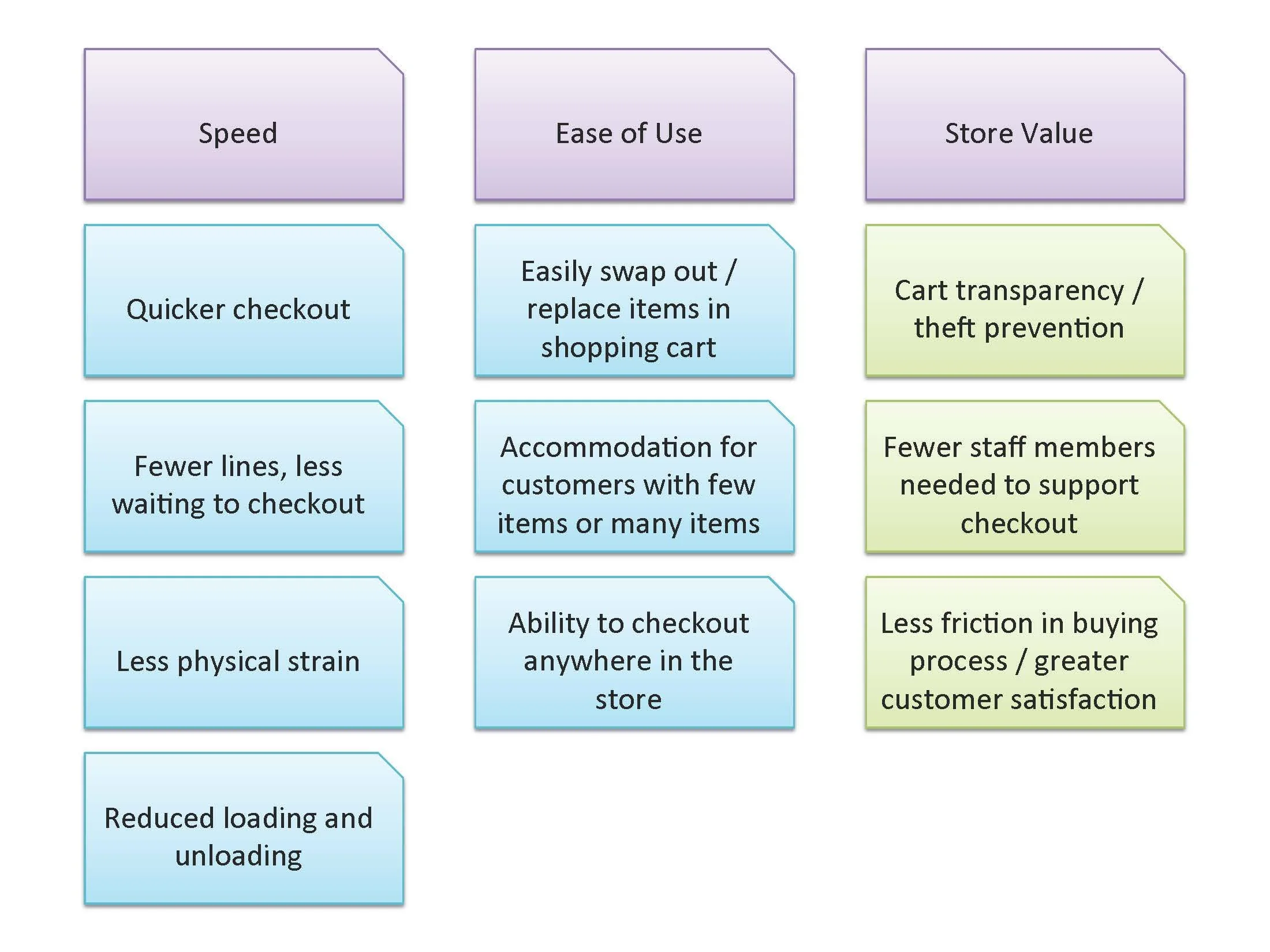
For example, once customers add all necessary items to a shopping cart, they must endure long lines to checkout. This checkout process then requires emptying out all of the items in the shopping cart onto a conveyor belt, where a store clerk scans each item individually by hand. Typically an additional store clerk is required to refill the shopping cart once again. 

This process is not only slow, but physically grueling.

Clearly, there was a huge opportunity to make this process faster and less analog. It became apparent to me that a self-scanning system could reduce the repetitive lifting that customers would typically have to perform, not to mention the filling, emptying, and re-filling of a shopping cart.

Years before the first Amazon Go stores opened, my design for cashierless checkout was inspired by a single piece of technology that is abundant in many retail stores, but is almost never present in supermarkets: RFID tags.

The prototype I made would require supermarkets to outfit shopping carts with RFID readers, as well as digital displays to provide users with feedback on what they were adding to their physical carts. It was aimed at helping customers get in and out of the store in less time, while also limiting friction in the process and reducing customer frustration.

It’s incredibly rewarding to see that Amazon continued to build on this same concept to make the physical shopping experience smoother. 

More recently, Amazon has even announced that it’s expanding this experience, along with its own smart shopping carts, to Whole Foods locations next year. 

What was exciting about my concept, as well as Amazon’s iterations, is that cashierless shopping isn’t as revolutionary as it may seem. 

RFID and even QR codes are not new technologies. RFID tags are less than 1 mm thick and can be attached to all items. While bar codes require manual operation, RFID tags can wirelessly transmit data, so that collecting product information can happen within seconds.

Over the past year, fast fashion retailer Uniqlo has also released self-checkout machines using this same concept, which quickly reduced queue times in-store.

It just goes to show how a fresh perspective, and a new application for something already available, can dramatically reshape the most basic experiences.  

In Technology Tags amazon, cashierless shopping, hci
← Newer Posts Older Posts →

Copyright © 2026 David Lux